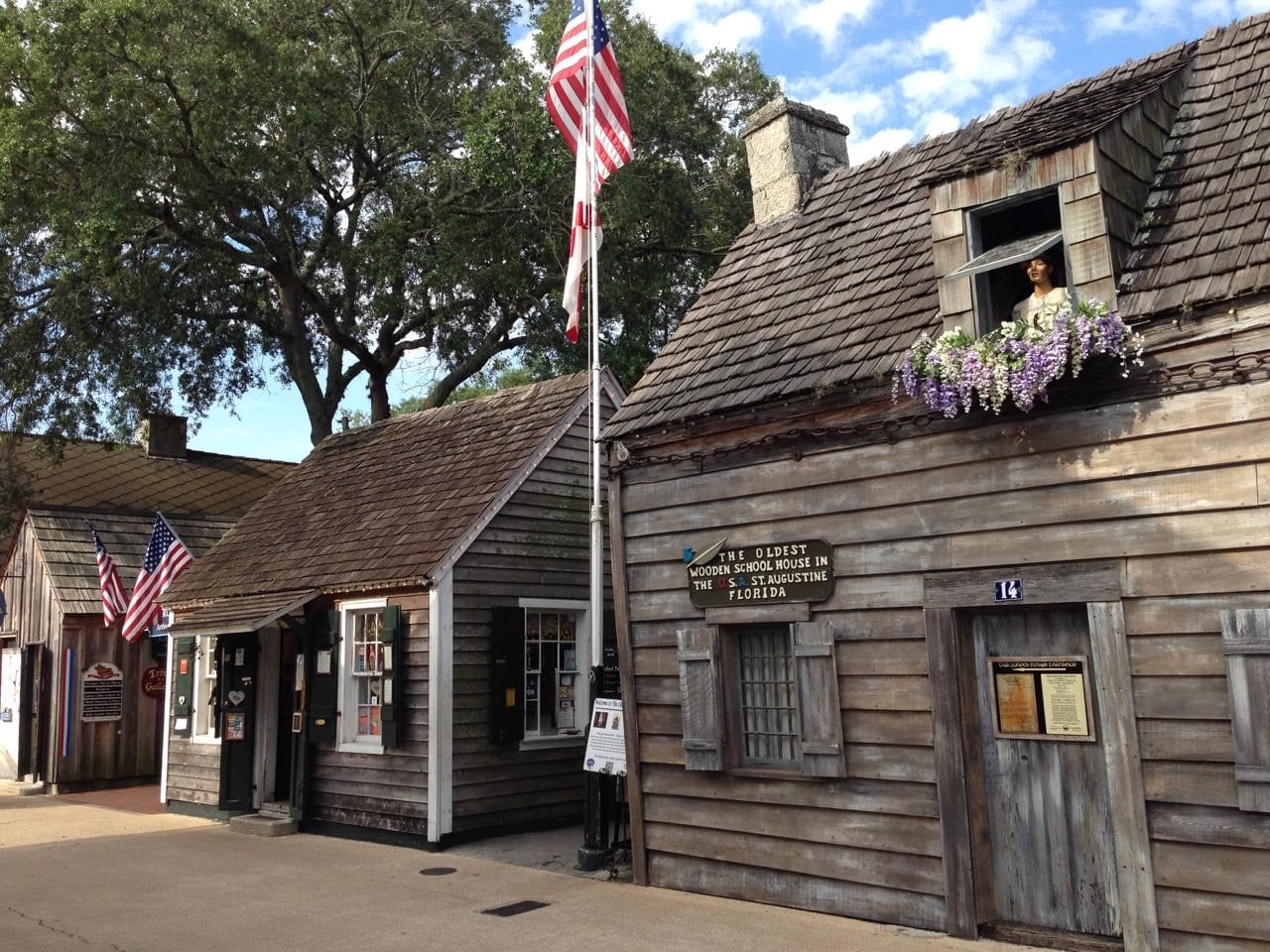
The Genopoly House sits near the northern end of what was once known as the Minorcan quarter. The “Minorcan” community included people from Minorca, Greece, and Italy who made St. Augustine their home after leaving New Smyrna. Juan Genopoly’s Greek roots are a reminder that the familiar name holds more than one story.
You’ll probably recognize this little wooden house by the “Oldest Wooden School House” sign out front. But before the schoolhouse name brought visitors to its door, this was a family home connected to that community.
Juan Genopoly was a Greek carpenter who came to St. Augustine in 1777 with the survivors of Andrew Turnbull’s New Smyrna colony. After years of harsh labor and mistreatment, they left the settlement and made their way north, seeking protection in British St. Augustine. Here, Genopoly and his wife, Antonia Rosello, built a life together, raised a family, and made this property their home. Their story is part of a community starting over, one whose descendants are still part of St. Augustine today.
To picture the old Minorcan quarter today, think of the stretch of St. George Street from the City Gates south to Hypolita Street, where you’ll find the Columbia restaurant. That roughly places you in the neighborhood where many of the families from New Smyrna made their new homes.
Imagine arriving in a town after leaving nearly everything behind. You needed work, a place to live, and some assurance that your family would be safe. A carpenter’s skills could help with the first two. Over time, families like the Genopolys put down roots, established households and businesses, and helped shape the neighborhood around the northern end of St. George Street.
The house had other chapters, too. In 1931, photographer William J. Harris purchased the building and began showing it to visitors as the “Oldest Wooden Schoolhouse,” complete with a recreated classroom. The family home had become a tourist attraction, and the schoolhouse name became the one most visitors knew.
In Walking St. Augustine, Elsbeth “Buff” Gordon gives us something to think about while we take that selfie under the sign. She points to Voorlezer’s House on Staten Island, New York, then understood to be a wooden schoolhouse from 1696. Newer research at Historic Richmond Town tells a different story. The earlier Dutch school building was replaced, and the house standing there today dates to about 1769. Its age alone doesn’t settle which surviving wooden schoolhouse is oldest. It’s a good reminder to enjoy the sign, then look a little closer at the story behind it.
The schoolhouse attraction is part of this house’s history, too. But while you’re looking at the wooden walls and the sign, give a thought to the family who called this place home. If these walls could talk, the best stories might be about the people who lived here. What did they leave behind? How did they start over? And what were the everyday moments that made this little house a home?
You’ll find the Genopoly House at 14 St. George Street, just south of the City Gates. It’s also a stop on the Visitor Center to Plaza walking guide in the SAHP app. Bring the guide along and let the stories unfold as you walk.