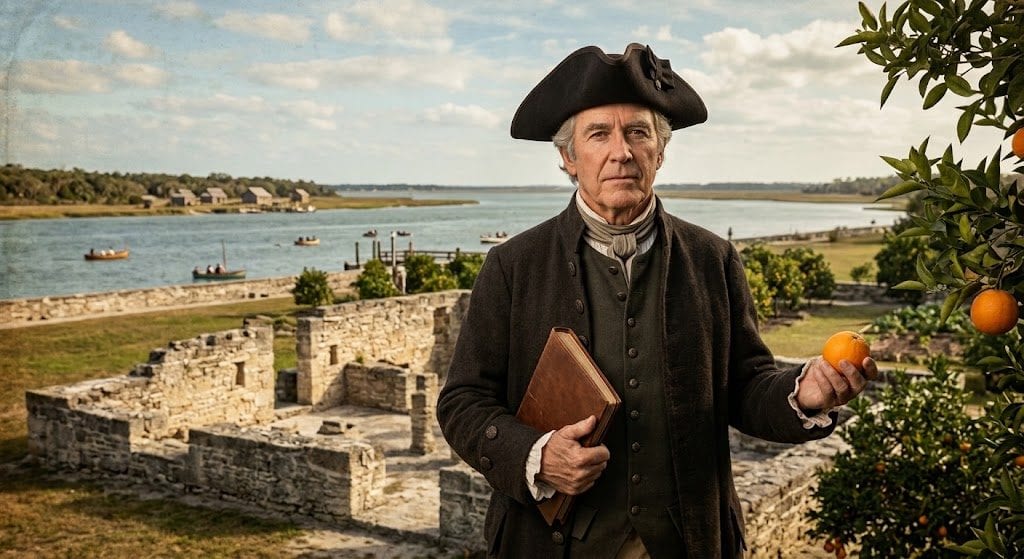
Fish Island Preserve offers a different way to explore St. Augustine: a walk through coastal woods and salt marsh, with a name that leads back to one of the city’s most complicated colonial figures. Jesse Fish was a merchant, a citrus grower, and a participant in property transactions that remained disputed long after Florida changed hands. He was also an enslaver and slave trader. Understanding the place means considering all of that history. [1, 2, 3]
A New Yorker in Spanish St. Augustine
Fish came from New York to St. Augustine as a boy. He lived with the Herrera family, learning Spanish language and customs, and worked for Walton and Company, a trading firm. His career included both commercial agency work and sailing its vessels. Those connections placed him between the Spanish town and the wider Atlantic trading world. [1]
That background became particularly important after the 1763 Treaty of Paris transferred Florida from Spain to Britain. Departing Spanish residents had homes and land to sell, but finding buyers was difficult. Through an arrangement with Spanish representative Juan Elixio de la Puente, Fish took responsibility for many properties, with the expectation that he would sell them and forward the proceeds to their former owners. [1]
It was an arrangement that produced lasting disputes over ownership, payment, and Fish’s handling of other people’s interests. Historian Clara Talley Kingston describes the difficulty of separating property that was rightfully his from property belonging to the former residents. Calling him simply the man who bought an abandoned city misses those unresolved obligations. [1]
The grove called El Vergel
Across the water on Anastasia Island, Fish developed El Vergel, a name associated with a garden or orchard. Citrus was a commercial enterprise there. Kingston’s account describes shipments of fruit and orange shrub, a mixture of juice and spirits. Fish Island’s history reaches into the development of Florida’s citrus trade, well before the industry became a familiar part of the state’s identity. [1]
The pleasant image of a grove is only part of the story. The preserve’s management plan documents Fish’s involvement in the slave trade and cites records of enslaved people he owned. The people subjected to that system belong in our understanding of the plantation alongside its proprietor and produce. This was a place of commerce and cultivation within a society that treated human beings as property. [2]
A landscape older than its name
Jesse Fish did not begin the human history of this place. The City of St. Augustine describes occupation extending back more than 4,000 years. Long before a colonial plantation gave Fish Island its modern association, people were living in and using this coastal landscape. [3]
That longer perspective makes a visit more rewarding. The name on a map introduces one person, but the ground holds evidence of many lives. Look at the landscape with that in mind, and leave shells, fragments, and other objects where they lie.
Visiting Fish Island today
The city lists Fish Island Preserve at the west end of Plantation Island Drive South. Its 62 acres include maritime hammock and salt marsh, with nearly two miles of trails and interpretive signs in the center of the property. Posted opening hours are sunrise to sunset. These visitor details were checked September 25, 2026; consult the city’s current preserve page and on-site notices before your visit. [3]
Stay on marked trails, leave natural and cultural materials in place, and carry out what you bring in. Approach it as a landscape to explore and learn from, rather than a reconstructed plantation attraction. [3]
Keep exploring with SAHP
A place name can be the beginning of a much larger story. Download the free St. Augustine History Project app to explore more of the city’s historic places and walking guides. Let what you discover at Fish Island prompt your next question about St. Augustine, and take that curiosity with you into the city.