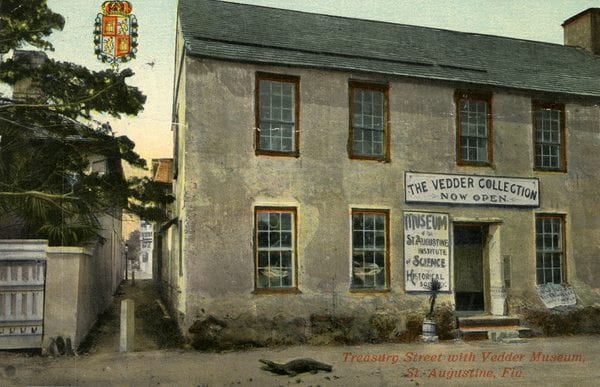
A quarter bought admission to one of St. Augustine’s most unusual attractions in 1894. At the corner of Bay and Treasury streets, Dr. John Vedder offered visitors a museum and zoological garden filled with Florida animals, preserved specimens, and objects that promised a close encounter with the unfamiliar. Children paid ten cents. A season ticket cost a dollar.
The museum is gone. Its story survives at the corner of Treasury Street and Avenida Menendez, where the Rodriguez Arsian House Remnant connects a colonial household, a tourist attraction, and an early home of the St. Augustine Historical Society.
Before the curiosity museum
The site’s historical marker identifies the house with Antonio Rodriguez Arsian, a soldier during Florida’s First Spanish Period. According to the marker, his family left for Campeche when Britain took control of Florida in 1763, and his heirs eventually regained the property in 1790. Those changes of ownership place the site within the larger story of families displaced by imperial transfers.
By the late nineteenth century, this old house had acquired a different purpose. The marker dates Vedder’s lease to 1887. A dentist and taxidermist, he made the building a place where paying visitors could examine Florida’s wildlife alongside historical curiosities.
What twenty-five cents promised
An advertisement in The Tatler of Society in Florida on February 17, 1894, makes the business tangible. It placed the museum on Bay Street at Treasury and directed visitors toward its flags. The inventory included live and mounted animals, birds, fish, and reptiles. Alligators shared the advertisement with wildcats, rattlesnakes, and a manatee.
The same notice offered live alligators boxed for shipping. That detail can be startling to a modern reader, but it belongs to the museum’s own sales pitch. Vedder was selling encounters with Florida and, in some cases, animals that tourists could take away.
The advertisement also used extravagant claims about the rarity and size of its specimens. Those claims tell us how the attraction competed for attention. They are not, by themselves, scientific verification. Reading the advertisement carefully lets us recover the experience Vedder promised without accepting every promotional statement as fact.
A collection becomes a headquarters
After Vedder died in 1899, the Historical Society purchased his collection. Historian Thomas Graham records that Dr. DeWitt Webb advanced $600 for the purchase and that repayment took years. The Society leased the building, gaining its first home and headquarters of its own.
The distinction matters: buying a collection is different from buying the house that contains it. Graham’s account describes a collection purchase and a building lease.
By 1911, the Society also leased the Sanchez House behind the museum, facing Charlotte Street, to accommodate its expanding holdings. Natural specimens and historical objects accumulated together. The collection included maps, Confederate currency, Spanish-period relics, fossils, and cannonballs from the fort’s walls.
In May 1912, photographer W. J. Harris became curator. His postcard business and souvenir photography helped connect the museum with the visitor economy. Signs presented the Vedder building as a “House of History” and suggested it might be the “Oldest House.” That was a claim made to visitors, not proof that this building outranked every other surviving house in St. Augustine.
The fire and what remained
On April 2, 1914, fire swept through part of central St. Augustine and destroyed both the Vedder and Sanchez buildings. Much of the Society’s collection was lost. Some maps and paper documents survived because they had been kept elsewhere, at the public library on Hospital Street.
The Society continued. Later that year, it secured rooms at Fort Marion, now the Castillo de San Marcos, for museum displays. The bayfront fire had destroyed a home for the collection, but it did not end the work of preserving local history.
Look beyond the postcard
The historic postcard accompanying this story shows the museum before the fire: a two-story building with rows of windows and a sign advertising the Vedder Collection. Compare that substantial building with the surviving wall remnant, and the scale of what disappeared becomes easier to understand.
For your own walk, download the free St. Augustine History Project app from the Apple App Store or Google Play. Find “Rodriguez Arsian House Remnant” in the “Ponce de León Statue to Castle Warden” walking guide, and carry the history of this corner with you as you explore the bayfront.